


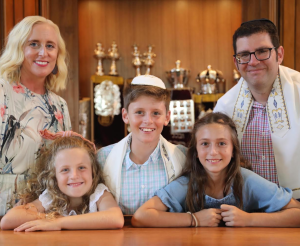





Rosh HaShanah – 5787
A few weeks ago, like so many people across Australia, as I listened to the news and caught up with what was going on online, I felt a terrible, uneasy premonition settling in.
The news was dominated by the Sydney Swans. On the eve of a finals campaign, a time when a club and a city are supposed to be united in optimism, the headlines were consumed by what was initially termed; “a severe breach of conduct”. Five players suspended. Police involved. A legendary club forced to confront an ugly crisis.
In the days that followed, the commentary played out standard public scripts. People looked for individuals to blame, debates raged over punishment, and footy fans were caught between distancing themselves, showing support for the victims, and sticking by our beloved Swans. Some may have distanced themselves too far, insisting; “That’s on those players. They broke the rules. They brought shame on the club. It’s their fault, not ours.”
When a scandal breaks, whether in sport, in politics, or in our own circles, our default human impulse is to build a wall between ourselves and the wrongdoers. We draw a neat line. They are the bad ones. We are the moral ones.
But today, as we enter the year 5787, Rosh HaShanah refuses to let us off the hook that easily.
On these Days of Awe, we stand before the Open Book of Life and engage in Cheshbon HaNefesh, a rigorous accounting of the soul. And when we turn to our shared prayers on Rosh HaShanah, we focus on a collective approach. When we recite Avinu Malkeinu, we start off by saying; “Chatanu Lefanecha – We have sinned in Your presence”. The whole prayer is written to reflect the plural, the community, all of us.
On Yom Kippur, when we recite the short and long versions of the Viddui, the confessional prayers, we once again speak in the collective plural. “Ashamnu, bagadnu, gazalnu” – “We have sinned, we have betrayed, we have neglected”.
Why? If you didn’t quarrel this year, why are you forced to confess to bickering and arguing? If you didn’t oppress or rebel, why must you ask for forgiveness for such behaviour?
The great 20th-century rabbi and civil rights leader, Rabbi Abraham Joshua Heschel, gave us the answer in ten words. Writing in the heat of the 1960s, reflecting on societal breakdown and moral indifference, Heschel wrote; “In a free society, some are guilty, all are responsible.”
Heschel made a profound distinction between guilt and responsibility.
Guilt is strict, legal, and narrow. Guilt belongs to the person who committed the act, the person who pressed send, who broke the law, who acted irresponsibly, or who breached the team’s code of conduct and behaviour.
But responsibility? Responsibility is wide. Responsibility belongs to the entire ecosystem that allowed that behaviour to feel permissible, normal, or consequence-free in the first place.
No sports team, workplace, school, family, or society degrades overnight.
Cultures do not break in a sudden flash. They erode slowly, through hundreds of unaddressed moments. Culture is built by what we tolerate when we think no one is watching. It is built when we look the other way because someone is a high performer, or because they are a politician or public leader. It is built when toxic behaviour is met with silence instead of pushback. It is built when the desire to belong or to win overrides our obligation to stand up.
The players involved in the Swans crisis hold the legal and personal guilt. But the crisis forced an entire institution, from the locker room to the board executive, to confront its responsibility.
The entire Swans community was shaken in the aftermath. Among supporters, there was grief and anger, but also painful contrasting perspectives. From those who wanted to shut their eyes and defend the club at all costs, to those who demanded justice in the face of unacceptable conduct and sought accountability out of true love for the team. Inside the men’s program, remaining players were left grappling with shattered trust. They knew that silence in the change rooms and the sports arena carries a heavy cost. Their emotions after the very next game showed how much this was impacting them.
And then look at the Swans’ AFLW team, stepping out onto the field amidst the media noise, bearing the burden of a brand they didn’t tarnish, showing us what dignity, integrity, and resilience look like under pressure. They reminded us that culture isn’t just degraded by bad actions, it is held together by those who hold the line when things get tough.
To their credit, the club’s leadership took a painful, necessary step. Standing down star players right before a finals series always carries the risk that it will cost the team dearly on the field. But real Teshuva, real repentance, always costs something. Maimonides taught that true Teshuva isn’t just saying “sorry”. It requires altering the underlying structures so that when the same temptation arises, we act differently.
This brings us back to our own lives, today, in the here and now as 5787 begins.
It is easy to point fingers at young athletes or public figures. It is far harder to turn Heschel’s mirror on ourselves and ask:
Where in my life am I settling for being a passive bystander?
In my office, my social group, amongst my family and friends, what bad behaviour am I enabling through my quiet convenience?
When have I said ‘not my business’ simply because I wasn’t the one holding the match?
Heschel’s warning was driven by a deep fear of indifference. Throughout Elul and on Rosh HaShanah, the Shofar is not sounded to remind us that bad people do bad things. The Shofar is sounded to wake us up from our own moral sleepwalking. It is an alarm clock designed to shatter the comfortable illusion that as long as we didn’t break the rule, we bear no duty to repair the damage.
Guilt is a heavy, paralysing emotion. It traps us in shame, turns us inward, and keeps us looking backward at what has already broken.
Responsibility is the exact opposite. Responsibility is forward-looking. In fact, if you break the word down, it is simply response-ability, our capacity to respond.
To say “I am responsible” is not to confess to a crime, it is to claim our power. When we accept that all are responsible, we stop being victims of our culture and start becoming architects of it. We realise that if a community’s standards can be pulled down by silence, they can be elevated by courage.
So what does this actually require of us in terms of our behaviour?
It means that when a boundary is crossed or we witness inappropriate behaviour, we no longer look down at our phones or look away, and wait for someone else to handle it. We speak up in the moment, setting the climate of the room.
It means that in our families and friendship circles, when gossip or casual cruelty begins to echo, we choose the slight awkwardness of saying “that’s enough” over the easy comfort of just going along with it.
It means that when we see leaders, whether in politics, in sport, or in our own institutions, making ethical compromises for short-term gain, we refuse to excuse it simply because they wear our team’s colours or they share our political views. True loyalty demands holding the institutions we love to the highest standards, not the most convenient ones.
And above all, it means choosing engagement over apathy. It means showing up, for the vulnerable, for our neighbours, and for the health of society, even when it is inconvenient.
On Rosh HaShanah, Jewish tradition teaches that the entire world rests on a balance scale, perfectly poised between good and bad. Maimonides writes that every single person, in every single moment, should view themselves as if their next action, their next word, their next intervention, their next act of decency could tip the scales for the entire world.
We cannot control what a group of people do in a hotel room late at night. We cannot control every decision made in the corridors of power. But we own the moral atmosphere of the spaces we inhabit, our homes, our offices, our schools, our community, and our country.
When the Shofar is sounded on Sunday, do not hear it as an alarm for someone else. Hear it as a direct call to you. Let its piercing sound shake us out of indifference this year.
Let’s be brave enough to move from guilt to agency, from bystanders to upstanders.
And as we step into 5787, may we build a community defined not by turn-the-other-way convenience, but by the noble, collective work of mutual responsibility.
May we all be written and sealed for a good, sweet, and honourable New Year.
Shabbat Shalom and Shanah Tovah U’Metukah.
Thank you for this very beautifully crafted speech that has helped me examine my own recent behaviour more carefully. The speech moves deftly between a recent breakdown in moral behaviour in a popular Sydney sports team to quotes from Maimonides and a general discussion on personal responsibility for societal ills. The Maimonides quote below was particularly meaningful for me
Maimonides writes that every single person, in every single moment, should view themselves as if their next action, their next word, their next intervention, their next act of decency could tip the scales for the entire world.